

A nationwide electrical distribution network needed a predictive maintenance and asset diagnostics platform — one that could continuously and reliably consolidate data from institutional systems, operational files, and field sensors to feed the AI models that prioritize inspection and maintenance across the grid.
The integration layer behind it was built entirely on open-source components, running inside the client’s own infrastructure, with no dependency on cloud services and no licensing by connector, message volume, or CPU.
The Core Replacement
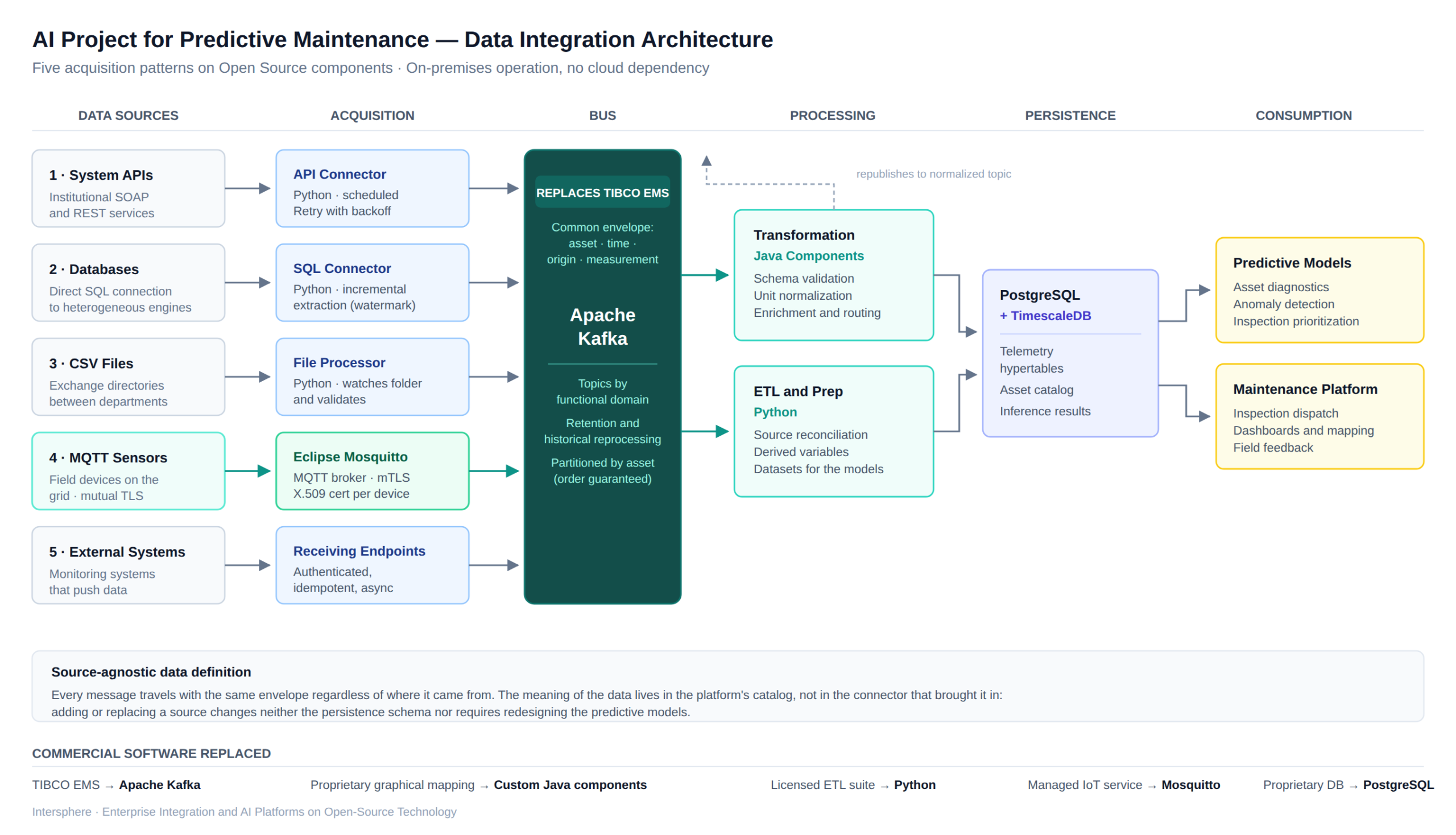
At the center of this project is the replacement of the corporate messaging middleware — TIBCO Enterprise Message Service (EMS) — with Apache Kafka as the platform’s integration bus. Message transformation, normally handled through proprietary graphical tools, was rebuilt with custom Java components, while extraction, transformation, and load processes run in Python.
Five Acquisition Patterns, One Common Envelope
The platform ingests data through five distinct patterns: institutional SOAP/REST APIs, direct database connections, CSV file exchanges, MQTT telemetry from field sensors (via Eclipse Mosquitto with mutual TLS), and receiving endpoints for third-party monitoring systems. Every message, regardless of source, travels through the bus in the same envelope, so the meaning of the data lives in the platform’s catalog — not in the connector that brought it in. That’s what lets new sources be added without redesigning persistence or retraining the models.
The Result
An enterprise-grade integration architecture with no licensing cost in the integration layer, no dependency on a single vendor, and a design where onboarding a new data source — or replacing an existing one — never touches the predictive models downstream.
Full technical detail is available in the complete case study: the four-layer architecture, all five ingestion patterns, the TIBCO-to-Kafka migration considerations, and the full commercial-software replacement table.